Honeycoin Nexus → Building the Internal Engine Behind Enterprise Payments

Replaced fragmented spreadsheets and chat-based workflows with a structured operations platform for trading,FX, and reconciliation.
I led the redesign of Nexus, Honeycoin’s internal operations platform, turning fragmented manual workflows into a structured system built for speed, traceability, and operational clarity.

The goal wasn’t to make things look better. It was to
make the company operate better.
My role
Lead Product Designer
Team
2 Designers, Head of Product, Product Manager, Engineers
Platform
Internal Admin Web App
Timeline
December '23 (5 months)

When “Self-Serve” Still Requires Humans (The Context)

Honeycoin is a B2B payments platform used by PSPs, banks, financial institutions, and IMTOs to move money across multiple markets.
Although the B2B platform enabled self-service flows, many clients still relied on Honeycoin’s internal team to execute trades, manage FX, and reconcile settlements.
This typically involved the CEO/CFO setting up multiple WhatsApp groups for different businesses/operators and manually updating a spreadsheet for reconciliation and audit with other team members.
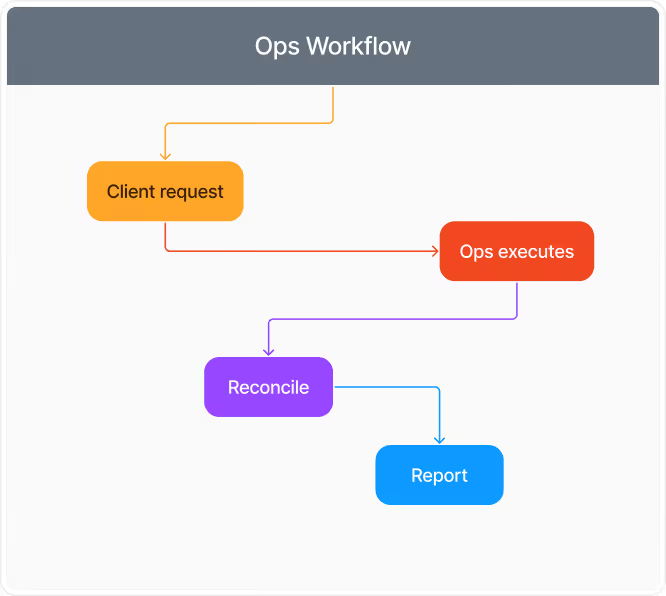
Behind many client transactions was an ops workflow that needed speed and accuracy.
This meant, behind every client transaction was a human-dependent workflow and as transaction volume grew, friction compounded quietly leading to errors through delays, context loss, and escalating operational risk.
To address these issue, we developed Nexus, an internal tool designed to automate the reconciliation process, improve data accuracy, and ensure enhanced operational efficiency for a process that had been manually operated for five (5) years.

The Ops Workflow Was Built on WhatsApp and Spreadsheets  (The Problem)

The issue wasn’t that the team lacked skill. The issue was that the tools (WhatsApp + Spreadsheets) the internal ops team was using for client interactions and trade management weren’t designed to support operational scale.
Trade data lived in one place. Conversations lived somewhere else. Reconciliation logic lived in another spreadsheet entirely. There was no single source of truth.
This worked when volume was low, but at scale, it created real operational risk:
#1 - Scattered data and inconsistent records
Operational risk due to the data and records been scattered across chats.
#2 - No single source of truth
So much time lost chasing context for trades, FX, or client status instead of executing transactions
#3 - Reconciliation Issues
Reconciliation errors and duplicated effort were hard to trace, often inaccurate, and lacked transparency.
#4 - Poor Team Collaboration
Low visibility across team members as handovers came with loss of critical information.
When something went wrong, the team spent more time finding information than fixing the problem. The system didn’t fail dramatically, it failed quietly, through friction, delays, and compounding risk.
The system of record was fragmented, chats for context and spreadsheets for tracking.

How do we solve it → We Needed a System of Record,
Not a Better Spreadsheet

This wasn’t about building an “admin panel”, or just a productivity problem or just plugging automations or a random fix to it. It was a scaling problem. Honeycoin had outgrown manual operations. The company needed an internal system that could:
Every step had legal implications. Regulatory bodies required specific data formats and documents, compliance workflows needed audit trails, and backend systems were tightly coupled to government processes. This meant improvements had to be incremental, production-safe, and legally accurate — even when that conflicted with ideal UX patterns.
  • Track every trade and payment as a structured record
  • Give the team shared visibility in real time
  • Make reconciliation auditable and repeatable
  • Reduce dependence on one person holding context
With these issues in mind, the question became:...
So...how might we...centralize and automate Honeycoin’s internal B2B operations so the team can reconcile faster, reduce errors, and serve clients with more confidence at scale?

The Strategy & Solution → Treat Ops Like a Product Team with “Nexus”

Internal users aren’t “less important” users—they’re high-impact users. Their needs are different: they need speed over polish, clarity over exploration, traceability over minimalism, reliable states and logs for audit

Introducing Nexus:

A product to improve Honeycoin's operational efficiency, enhance transparency and strengthen its competitive advantage in the B2B payments market.

The goals were simple:

Reduce reliance on manual process
Track & effectively monitor all B2B payments
Reduce reconciliation errors
Reduce reliance on Improve data integrity - a single source of truth for payment informationmanual process
Enhance customer service

To meet these goals, we narrowed down to 3 core features

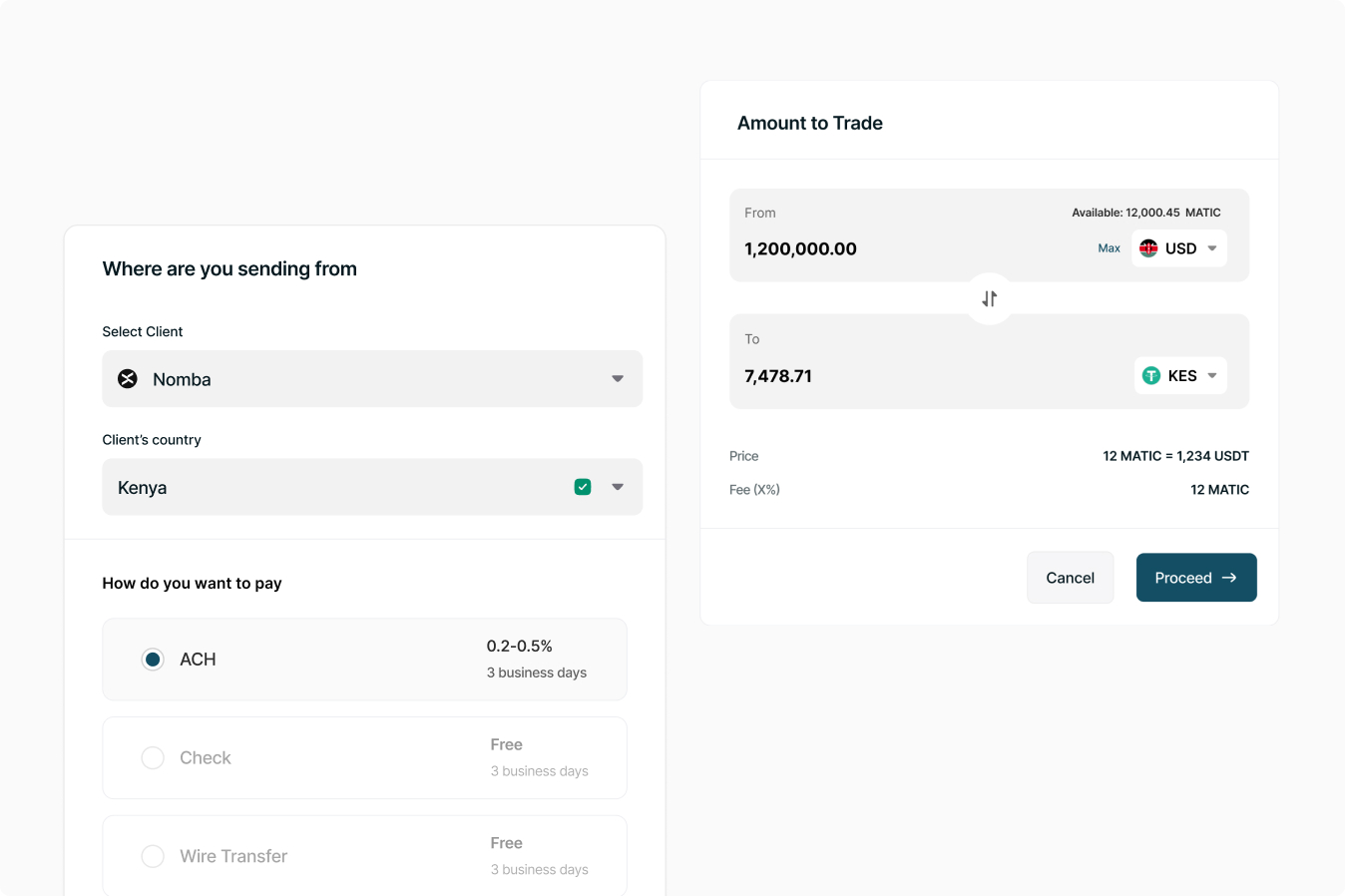
Instead of building a generic admin panel, we structured Nexus around three operational realities: trading execution, FX management, and client operations. This mirrored the team’s mental model and reduced context switching during high-pressure moments.
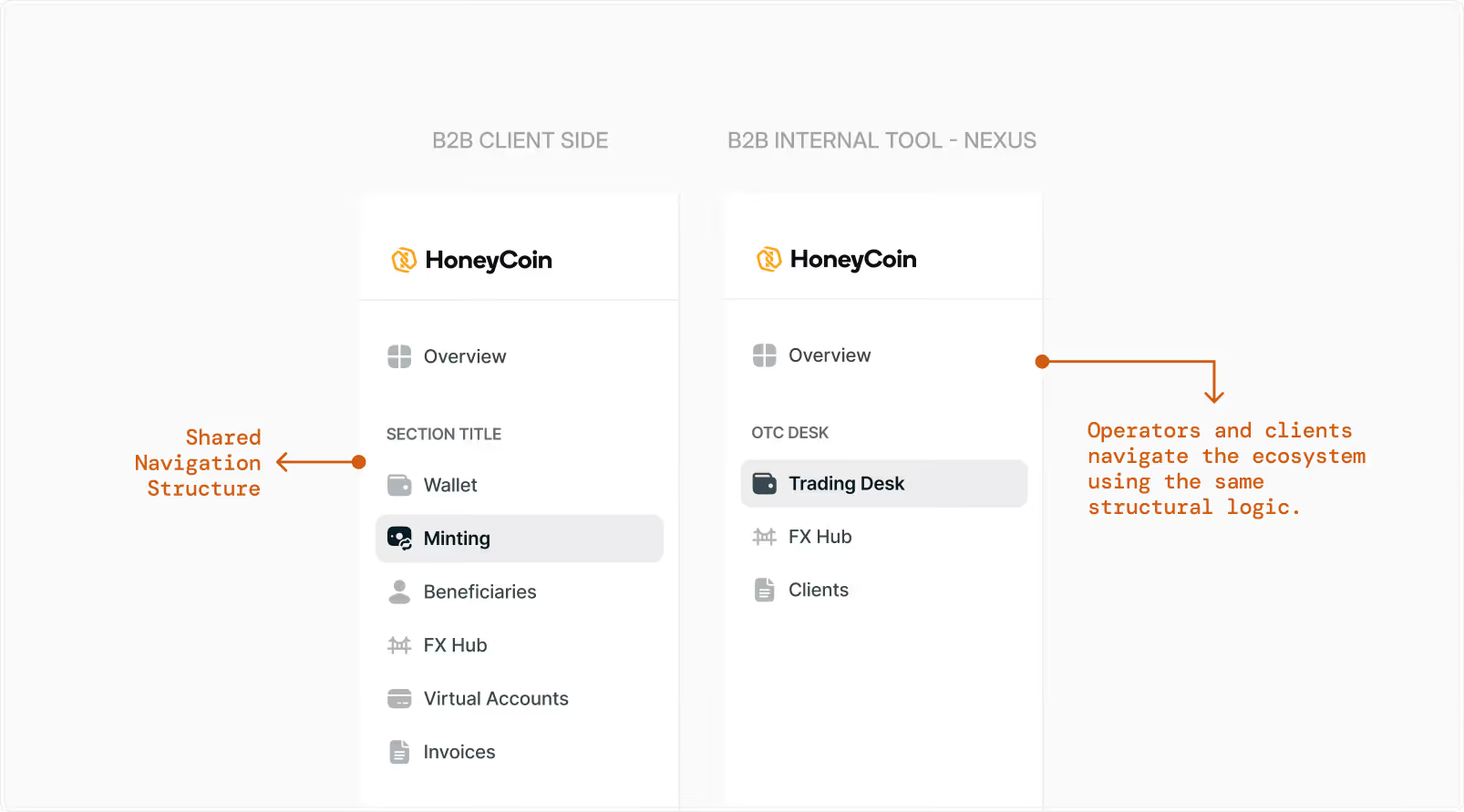
A key leadership decision was organizing Nexus around how ops teams think about work (desks) rather than how services are structured in the backend. This meant pushing for a job-based navigation over feature-based navigation.

What I Owned End-to-End

I led the end-to-end product design for Nexus, partnering with Honeycoin’s Head of Product and Product Manager, and collaborating with engineering through delivery.
This gave me the opportunity as lead product designer to own:
  • Workflow mapping and problem framing
  • Information architecture for internal operations
  • Core desk experiences (Trading, FX, Client)
  • Interaction patterns, tables, states, and permissions thinking
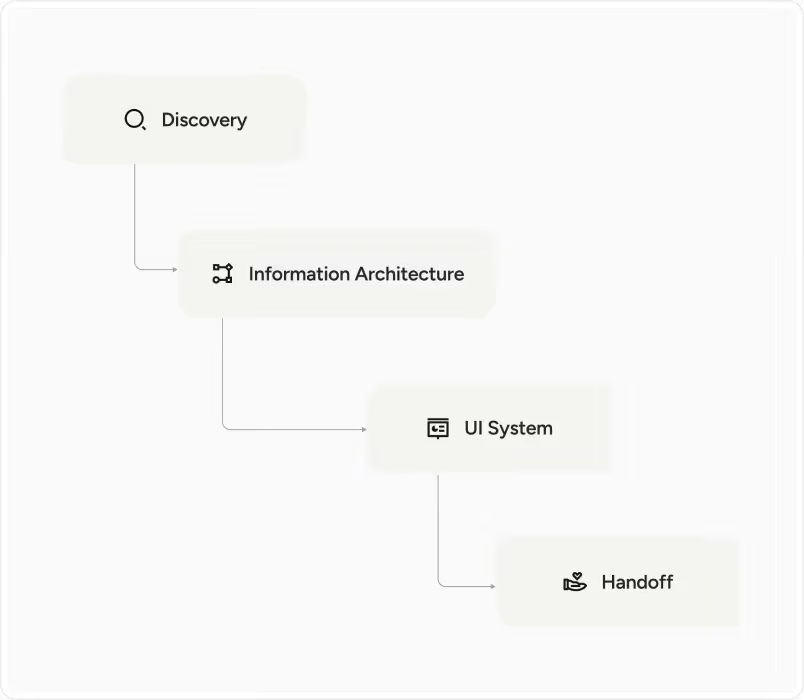
  • Design documentation and handoff
This was a systems redesign, not a feature addition.
I led design end to end, from mapping
workflows to shipping-ready specs.

The Core Experiences

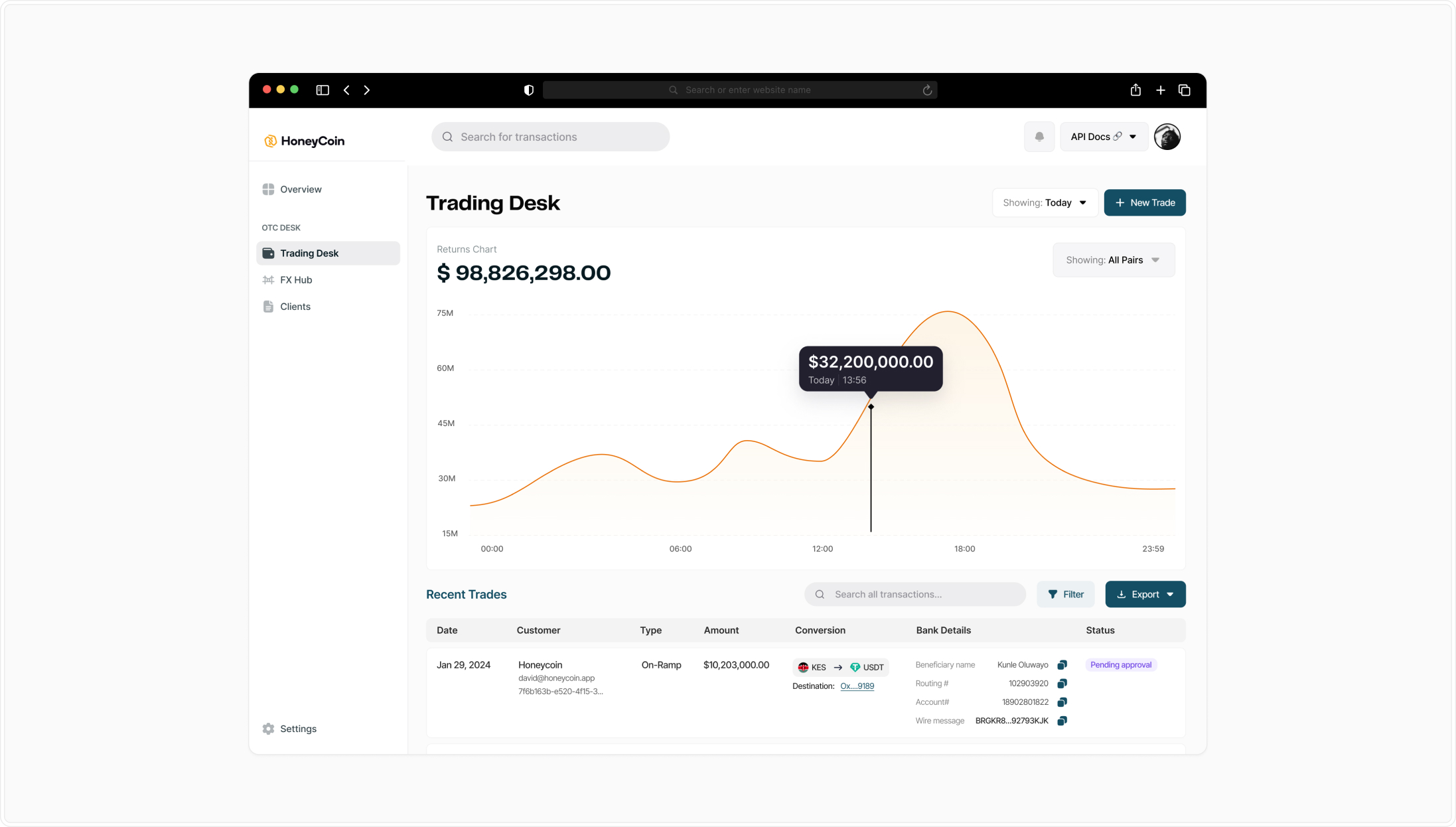
#1 - Trading Desk → Where Money Actually Moves

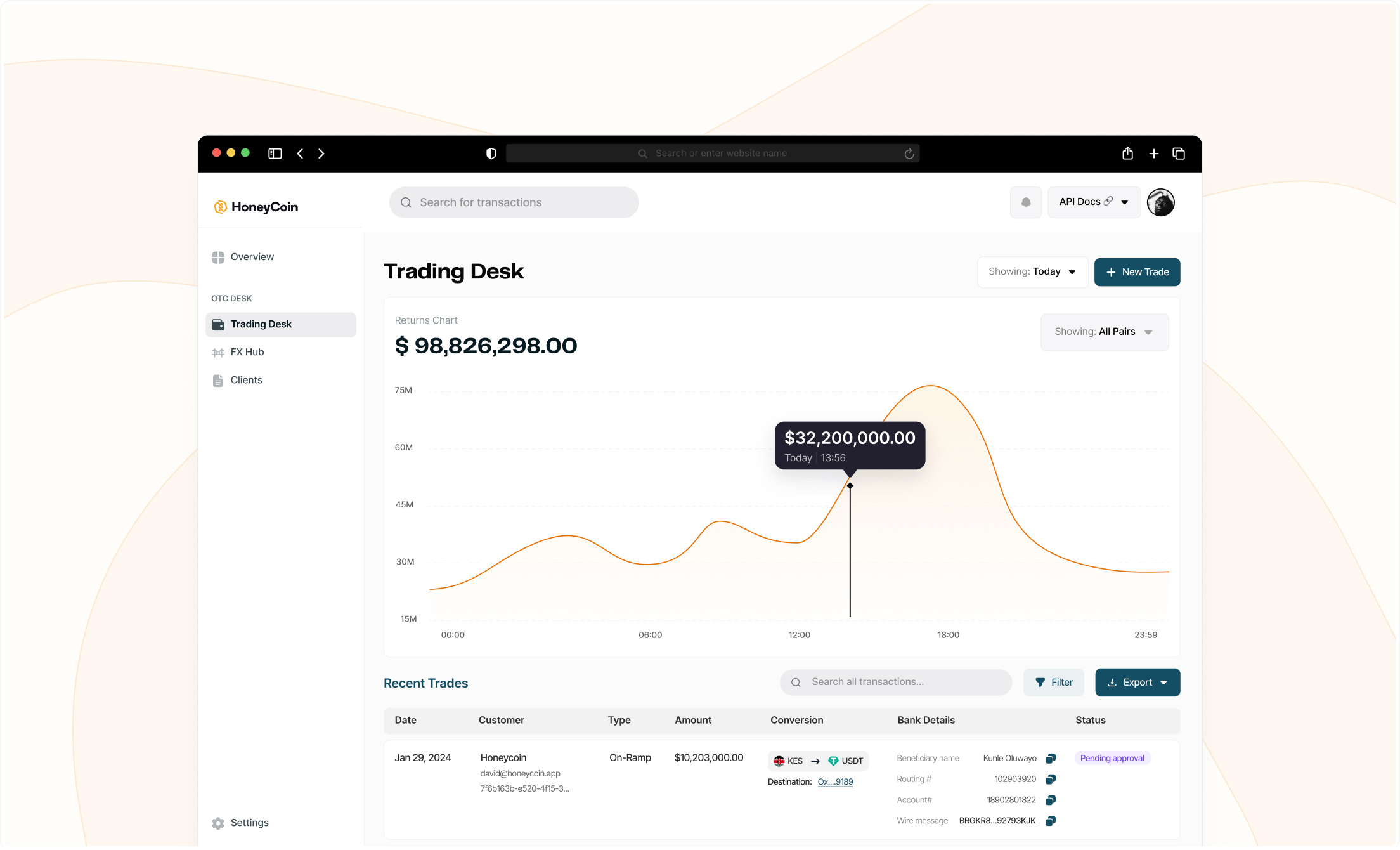
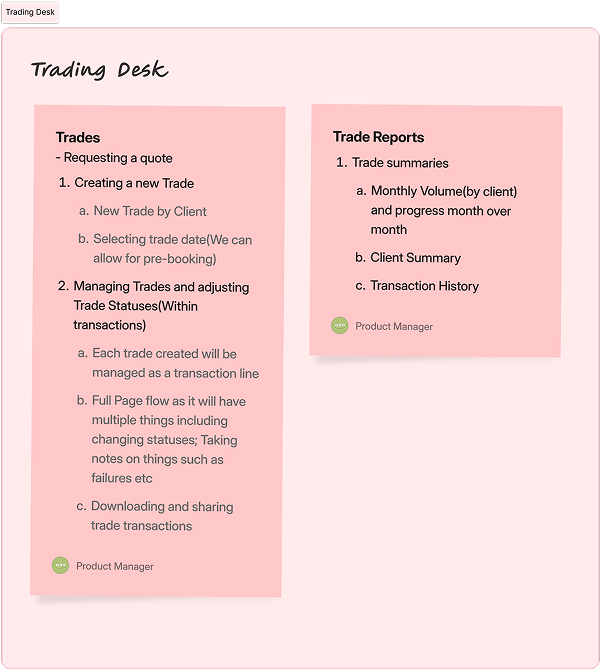
The Trading Desk became the operational heart of Nexus. Before this, trade execution lived across chats and spreadsheets, which meant no one had a real-time view of what was in-flight, blocked, or complete.
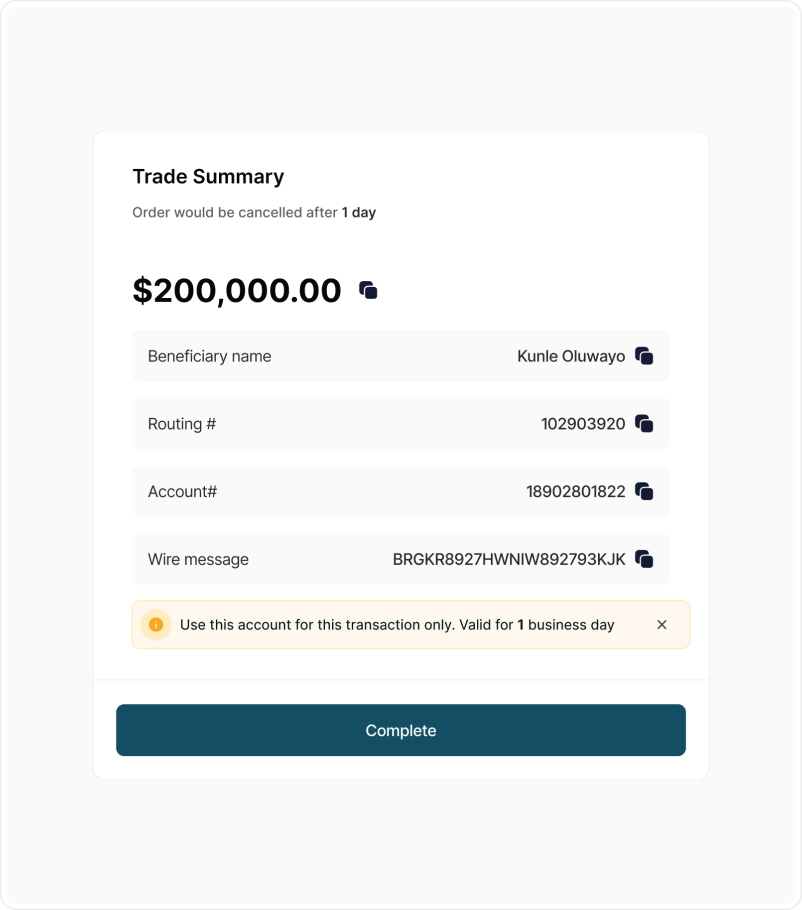
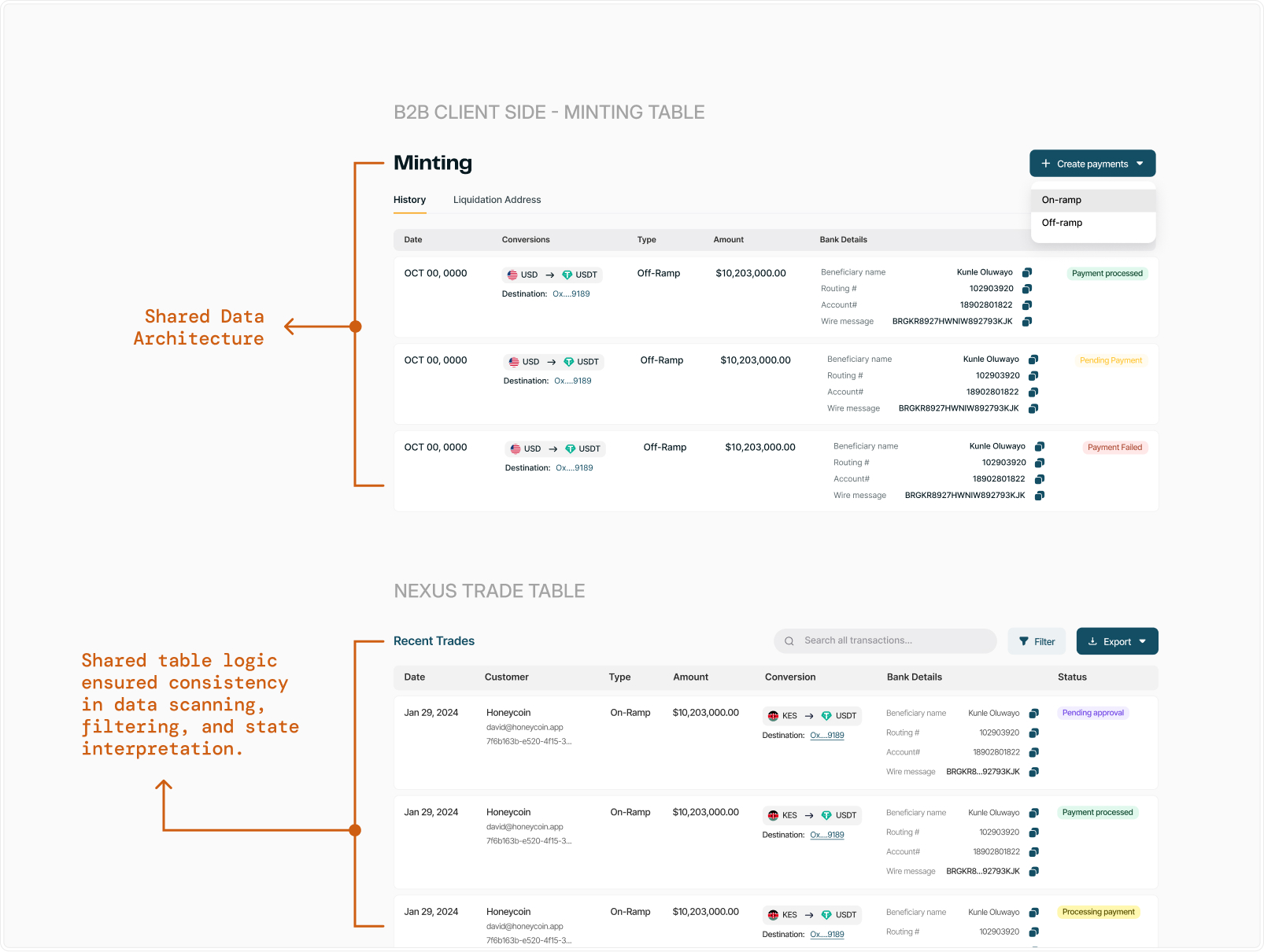
The redesigned Trading Desk consolidated every trade into a single operational record. Operators could initiate trades, track state changes, leave context for teammates, and export records for audits — all without leaving the system.

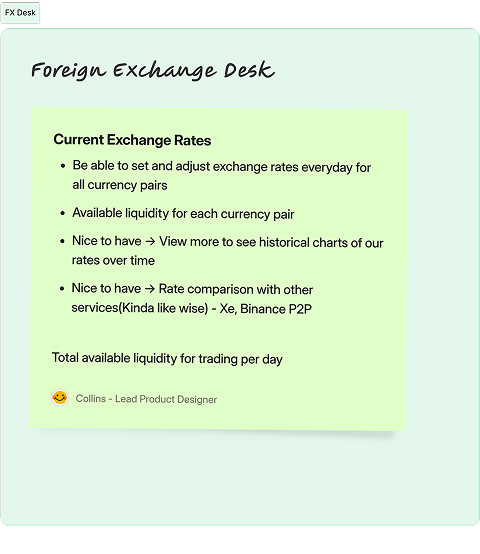
#2 - FX Hub → Making Liquidity Visible

FX decisions were previously buried in side conversations and spreadsheets. This made it hard to answer simple operational questions like:


“Do we have enough liquidity in this corridor right now?”
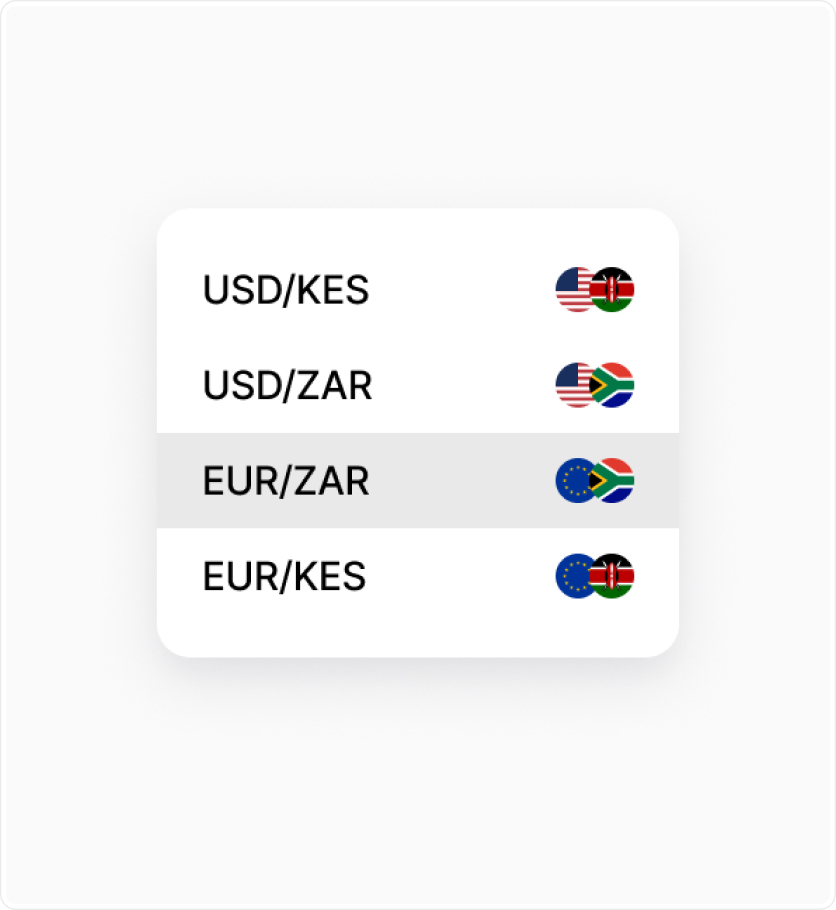
The FX Hub surfaced live rates, available liquidity per currency pair, and historical context for changes. This allowed operators to price trades confidently in real time, without asking around or checking multiple tools.

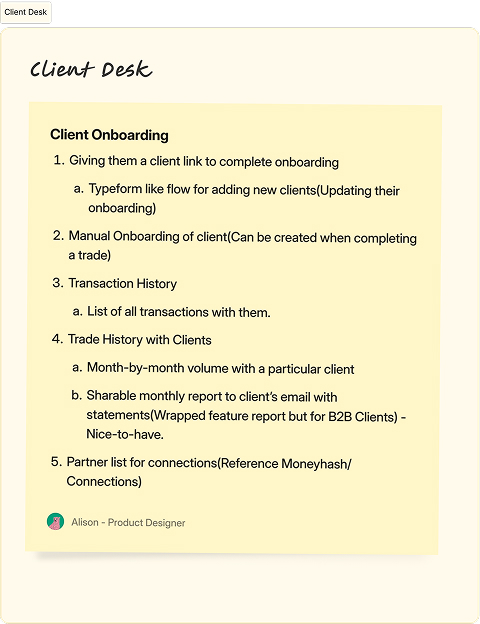
#3 - Client Desk → From Fragmented Context to Structured Records

Client onboarding and management was previously scattered across email threads, documents, and chat messages. This meant important context was lost when operators rotated shifts or when accounts changed hands.
The Client Desk centralized onboarding, client metadata, transaction history, and documents into a single profile. This gave the team continuity and made client context durable over time — not dependent on who happened to be online.

Reusing the B2B Platform’s Design System

Nexus shipped after the B2B dashboard redesign. I intentionally reused the same design language to keep Honeycoin’s ecosystem cohesive:
  • Table structures and filters
  • Form patterns and validation
  • Status badges and color semantics
  • Drawers and detail views
  • Layout rhythm and spacing
By extending the B2B design system into Nexus reduced onboarding friction for operators and shortened engineering build cycles. The internal platform felt like a natural extension of the product ecosystem, not an isolated admin interface.

Testing With Real Ops Scenarios

Because Nexus was replacing a five-year manual system, traditional usability testing wasn’t enough.This wasn’t a greenfield prototype. It was infrastructure migration.
Instead of static test cases, we validated the system against real operational scenarios, the exact workflows the team executed daily under time pressure. We walked through:
  • A new trade request from initiation to settlement
  • A trade exception and manual correction flow
  • FX rate updates and liquidity checks during peak periods
  • Client onboarding and transaction lookup
  • Audit-style review of historical records and status transitions
Each scenario was run with operators, not observers. We documented breakdown points, ambiguous states, missing context, and friction in handoffs.
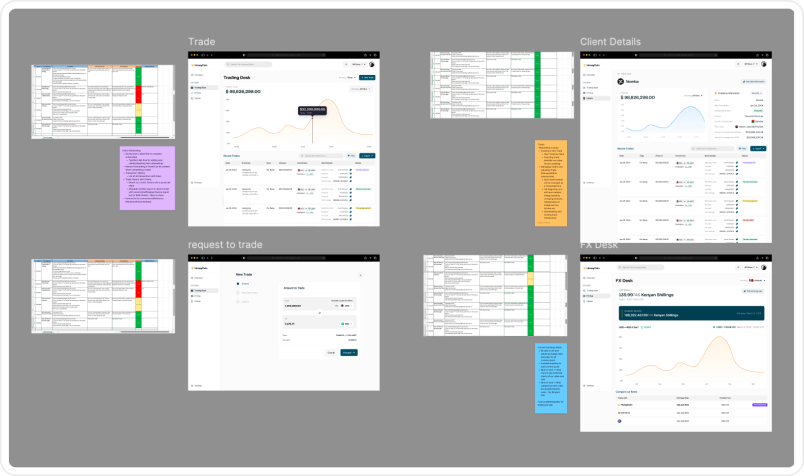
Validated with real workflows, including
exceptions and audit needs.
The goal was simple: If Nexus couldn’t survive real operational pressure, it wouldn’t ship. This process surfaced subtle issues early particularly around state logic and exception handling, and allowed us to refine the system before release.
As a result, Nexus didn’t feel like a new tool. It felt like the natural evolution of how Honeycoin already worked.
What We Measured Post-Launch

Because Nexus supported internal operations, impact needed to show up operationally. That meant success could not be defined by aesthetics or interface consistency. It had to show up in how the team operated.
Before redesign began, I aligned with Product, Engineering, Compliance, and Operations to define what “better” meant in operational terms. We agreed to measure improvement across three dimensions: speed, accuracy, and visibility.

Speed — Decision Velocity

Post-launch, transaction reviews and issue resolution cycles required fewer handoffs and less navigation. Teams processed workflows more smoothly, particularly during peak periods, without additional operational support.
Decision velocity improved, this was a big win.

Accuracy — Risk Reduction

Structured validation and clearer state logic reduced ambiguity in high-risk workflows. Operational teams reported fewer corrective adjustments and more predictable compliance handling.
In regulated systems, fewer internal corrections is real impact.

Visibility — Organizational Clarity

We centralized transaction states, compliance progress, and client signals into a single operational surface. Escalations decreased, and cross-team coordination became more structured and less reactive.
Ownership became clearer across the organization.

Reflections & Outcomes

Nexus evolved from a functional admin panel into a scalable operations platform.
As Honeycoin’s transaction volume continued to grow, internal handling became more structured and less reactive.
Improvements showed up in smoother peak periods, fewer escalations, and increased operational confidence.
Success was not measured in how modern the interface looked. It was measured in how the company operated after it shipped.
Leadership Feedback
Collins came into a pretty complex internal setup and didn’t try to overcomplicate it. He spent time understanding how we actually worked and built around that.

Nexus didn’t just look better, it made our day to day operations smoother and more structured.

It’s one of those changes where you don’t notice it immediately, but over time you realize how much calmer everything feels.
David Nandwa, Founder
THE END